Birth Name: Ray Charles Leonard
Nickname: “Sugar Ray”
Birthplace: Wilmington, North Carolina, USA
Weight Class: Welterweight / Light Middleweight / Middleweight / Super Middleweight / Light Heavyweight
Stance: Orthodox
Professional Record: 36 – 3 – 1 (25 KOs)
Years Active: 1977 – 1997
Biography
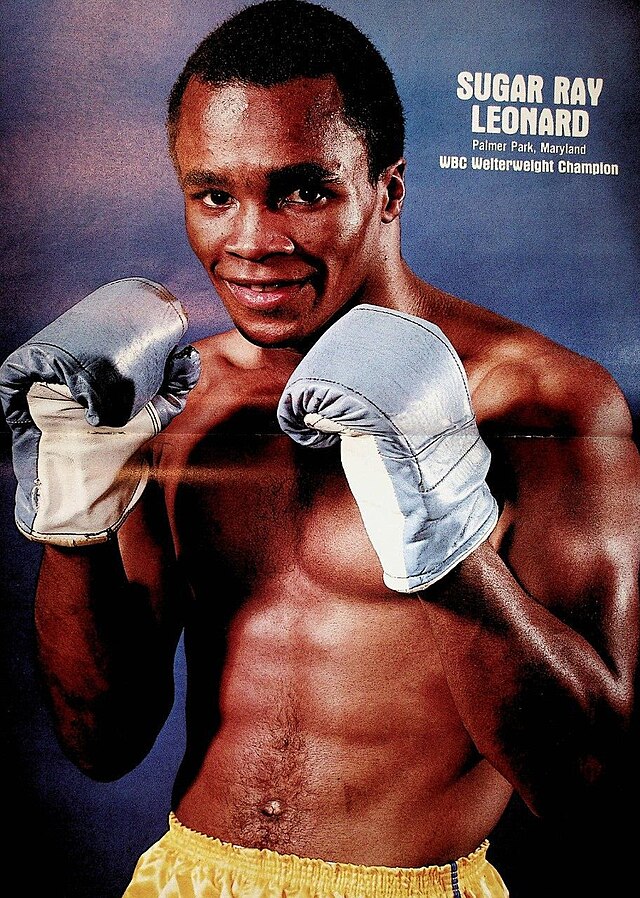
Sugar Ray Leonard redefined boxing for the modern era. Charismatic, intelligent, and dazzlingly fast, he combined the showmanship of Ali with the precision of Robinson, becoming one of the sport’s most celebrated champions of the late 20th century.
Leonard first gained fame as a 1976 Olympic gold medalist, representing the United States in Montreal. He turned professional in 1977 and within three years captured the World Welterweight Championship, defeating Wilfred Benítez. His 1980 clash with Roberto Durán, the famous “No Más” rematch, and his victories over Thomas Hearns and Marvin Hagler cemented his legacy as the face of the 1980s boxing renaissance.
A five-division world champion, Leonard’s combination of speed, tactical brilliance, and star power brought boxing back to mainstream prominence on network television. Outside the ring, he became one of the first boxers to transcend the sport as a global media personality and humanitarian.
Sugar Ray Leonard in the Hobby
Leonard’s cards mark the beginning of modern boxing collecting — colorful, glossy, and widely distributed across international markets. His earliest appearances coincide with the rise of Panini’s global sports brands and the mainstream popularity of trading cards in the 1980s.
Rookie & Early Issues
1979 – Panini Campioni dello Sport (Italy): Widely recognized as Sugar Ray Leonard’s true rookie card. Issued shortly after his Olympic triumph, featuring a clean headshot and distinctive red Panini border.
1980 – Sportscaster Series (Italy/UK): Large-format card series covering athletes from all sports; Leonard’s early entry captures him in his first professional world title run.
1981 – Panini SuperSport (Italy): Key early post-championship card showing Leonard at the height of his fame, printed in multiple language versions.
1986 – Panini Supersport / Sports Illustrated Stickers (International): Early glossy sticker issues distributed across Europe and Latin America, highlighting Leonard’s crossover appeal.
Registry Metadata
Earliest Issue: 1979 Panini Campioni dello Sport (Italy)
Rookie Year: 1979
First Mainstream U.S. Card: 1981 Panini SuperSport (U.S. distribution)
Key Sets: 1979 Campioni dello Sport, 1980 Sportscaster, 1981 Panini SuperSport, 1986 Panini Supersport Stickers
Known Variants: Panini issues vary in language and numbering; Sportscaster cards released in both metric and imperial measurement formats
Grading Rarity:
– 1979 Campioni dello Sport: PSA population ≈ 60; high-grade (PSA 9+) examples particularly scarce due to thin paper stock
– 1981 Panini SuperSport: PSA population ≈ 120; condition sensitive with frequent surface wear
Recent Notable Sales:
– 1979 Campioni dello Sport (PSA 9) — $3,850 (2024)
– 1981 Panini SuperSport (PSA 10) — $1,750 (2023)
Legacy
Sugar Ray Leonard’s influence extends beyond championship belts — he was the first modern fighter to blend elite skill with media savvy, sponsorships, and crossover fame. His rivalries with Durán, Hearns, and Hagler defined an era of boxing excellence rarely matched before or since.
In the hobby, Leonard’s 1979 Panini rookie card stands as a milestone in modern boxing collecting — the link between classic tobacco heritage and global sports-card culture. For collectors, it represents the birth of boxing’s television age and the arrival of a new kind of champion: elegant, fearless, and forever Sweet as Sugar.